ILO convention 193: the path to protect workers in app platforms
With support from civil society, a Rio Grande do Sul app driver brought demands of Brazilian platform workers to the International Labor Conference, contributing to the debate that resulted in the adoption of Convention No. 193
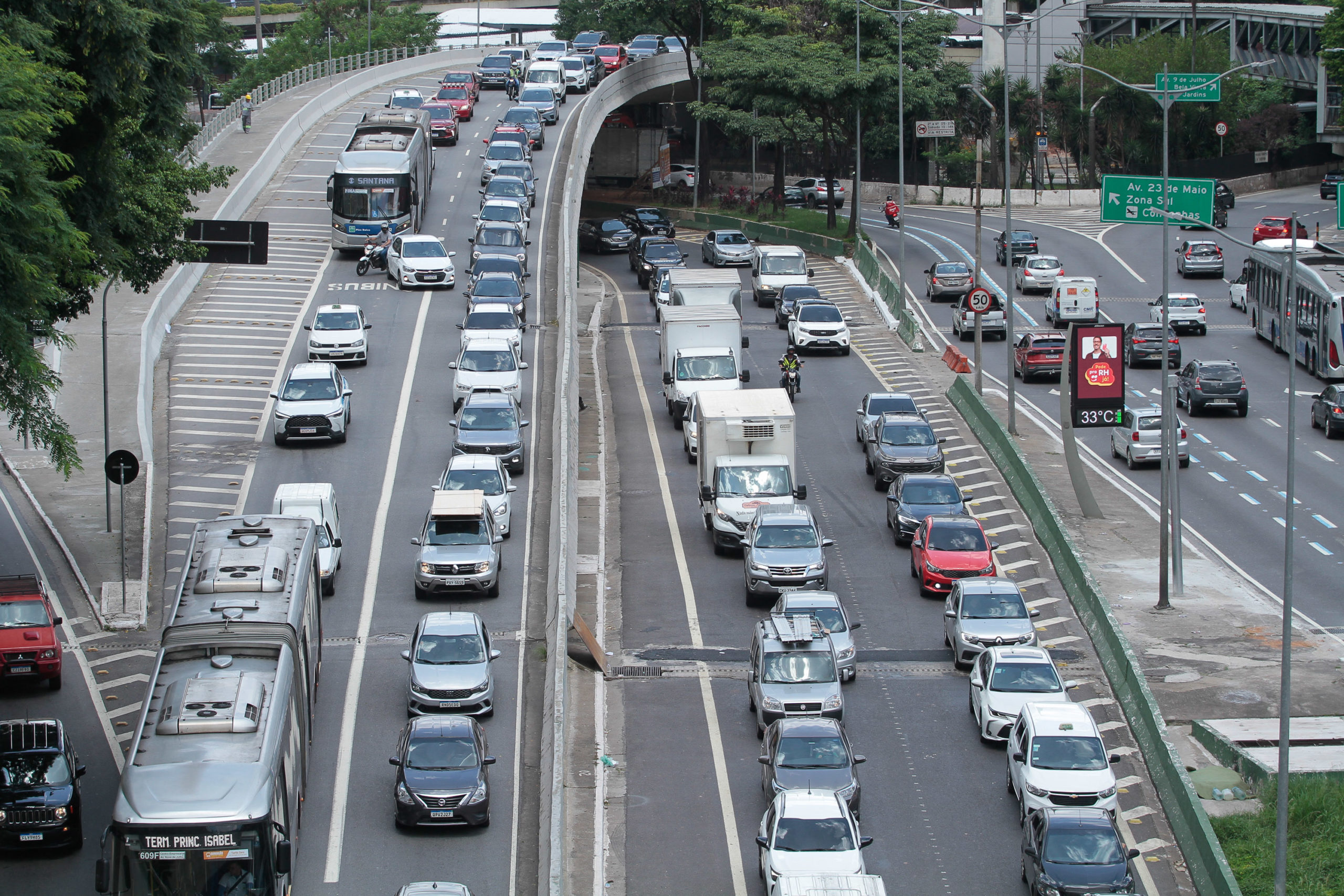 Vehicles are moving intensely along the North-South corridor in the central region of São Paulo, Brazil, on Monday, March 4. (Photo by Bruno Escolastico Sousa Silva/NurPhoto) (Photo by Bruno Escolastico Sousa Silva / NurPhoto via AFP)
Carina Trindade has driven through the streets of Porto Alegre (RS) as an app driver for ten years. Active on two platforms, she usually works into the early morning, with workdays that can exceed 12 hours in length. Her crisscrossing of the state’s capital continues into the weekends, which tends to be more profitable for those who depend on this type of work.
A solo mother, she always divided herself between long hours on the wheel and caring for the family. Even with a double workload, Trindade also found time in her life to defend the interests of her fellow workers: she presides the Individual App-based Private Passenger Transportation Drivers Union of Rio Grande do Sul and became an active voice in the organization of workers in that sector.
Her involvement with the collective struggle began with a concrete safety concern. Drivers’ lives were at risk. “When I started out, the largest problem was mugging and robbery-homicides of app drivers. That was when I joined the union and began to join demonstrations”, she says. “On one demonstration, we had three thousand drivers in front of the platform headquarters”. According to her, worker mobilization helped pressure sector companies to adopt protection measures, helping reduce episodes of violence against drivers.
Read more

She then understood that the problems went beyond the physical safety of workers. The scenario pointed to an absence of labor rights and low platform support. Today, Trindade dedicates some of her routine to the expansion and strengthening of the gaucho union, which gathers over 300 affiliates. Out of this total, about 100 of them take an active part in the entity’s activities.
Organizing the category, however, is no simple task. High driver turnover hinders approximations between workers and the union. Besides, leaders face discourses, particularly in social media, questioning or delegitimizing collective organization.
The defense of dignified working conditions brought Trindade beyond Brazilian borders. In June 2026, she represented Brazilian workers at the 114th International Labor Convention (ILC), held in Geneva, Switzerland.
During the conference, Trindade brought demands presented by Brazilian workers, including the need for the new international framework to incorporate a gender perspective. In other words, acknowledging historic inequalities between men and women in the context of platform-based work. Women represent 6.7% of app drivers in Brazil, according to data from the IBGE analyzed by Fundação Getúlio Vargas.
Convention No. 193
The main results of the summit at the International Labor Organization (ILO) was the adoption of Convention no. 193 on Decent Labor in the Economy Platform. The text was passed by a majority of votes: 406 votes in favor, 8 against, and 36 withdrawals.
Convention no. 193 is the first international labor standard dedicated specifically to platform economy. The document can affect at least 435 million workers worldwide who work through digital apps and platforms in areas such as transportation, logistics, domestic work, and service provision.
In Brazil, this accounts to around 1.7 million people working through digital platforms and service apps, equivalent to 1.9% of the population employed in the private sector. The data comes from a survey carried out in 2024 by the Brazilian Institute of Geography and Statistics (IBGE), in a partnership with Universidade Estadual de Campinas (Unicamp) and the Prosecution Office (MPT).
The new convention seeks to establish a global framework to ensure that technological innovation and new business models move forward with a protection of labor rights, fair competition, and sustainable economic development.
Civil society support
In the fight for dignified labor conditions, leaders like Trindade count on the support of civil society organizations.
“Our main concern with digital platform workers lies in fighting this extreme precariousness, made more severe by the absence of social guarantees”, states Amanda Camargo, project coordinator at Labora – Fundo de Apoio ao Trabalho Digno, an initiative of Fundo Brasil de Direitos Humanos.
Labora funds groups, movements and organizations that seek to face labor setbacks, prioritizing digital platform workers, in addition to domestic workers, recycling workers, fashion workers, and immigrants.
According to Camargo, the experiences of organizations supported by the fund show that digital platforms reproduce similar patterns in different countries.
“They install themselves at the margin of local labor legislation and operate this way until the State intervenes and establishes rules for these large monopolies”, she states. According to her, the management logic in these companies concentrates power in automated systems that regulate everyday work.
“The current ‘boss’ to these professionals is the algorithm. It’s the algorithm that dictates long and exhausting workdays, controls schedules, arbitrarily blocks drivers and deliverymen and unilaterally defines the remuneration to be paid”, she explains.
The demands presented by Trindade in Switzerland were the result of the Training Day on the 114th International Labor Conference, offered specifically to digital platform drivers and delivery workers. The event was held by Labora in a partnership with the Inter-union Department of Statistics and Socioeconomic Studies (DIEESE), Women in Informal Employment: Globalizing and Organizing (WIEGO), the Unified Workers’ Center (CUT), and the Solidarity Center.
The proposals touched upon complex aspects of the platform economy, such as the establishment of minimum remuneration based on mileage and on the local cost of living, the end of arbitrary blockings by algorithms without the workers’ right to defense, and access to social security (including the discussion on special retirement due to the hazards of a routine on the streets). The document also proposed discussions on specific protection for women against harassment and incentives to the professional and ethical training of workers, including topics on the impact of climate change in their work routines.
What Convention No. 193 entails
As the first global milestone regarding platform economy, Convention No. 193 seeks to assure that workers, regardless of their gender or contractual status, have access to fundamental rights and adequate protection, while acknowledging the opportunities created by digital platforms.
The text also discusses the impacts of automatic management and decision-making systems. The convention requires transparency, safeguards, and review mechanisms when automated decisions affect workers. It also assures freedom of association, collective bargaining, protection against discrimination, child and forced labor, in addition to the right to a safe and healthy workplace. It further encourages member-states to secure remuneration or proper pay to all workers, including those without a contractual employment bond.
Though it does not explicitly mention artificial intelligence, its provisions apply to automated systems used to monitor, assess, or make work-related decisions, including AI-based technologies.
According to the ILO, the convention acknowledges that platform-based work often exceeds national borders and may involve intermediaries.
“The convention includes provisions destined to ensure the effectiveness of its protections. This includes the requirement of being implemented in relation to digital work platforms, as well as intermediaries that operate in their territory, and the requirement of a clear definition of responsibilities respectively befalling platforms and intermediaries”, the organization stated in a press release.
Carina claims the text represents important progress by acknowledging problems faced every day by workers, such as arbitrary blocking, difficulty in accessing labor justice, and the need for transparent mechanisms to challenge arbitrary decisions made by platforms against workers.
Camargo, in turn, claims the main progress in Convention No. 193 is the international recognition that platform workers cannot remain in a legal grey area or without social protection.
“The standard establishes unheard of global guidelines on union rights, minimum remuneration, and work safety. On the other hand, crucial matters are still pending, such as the uniformity of the type of employment relationship, since the practical application and the control of these parameters will strongly depend on the correlation of forces and the legislative specificities of each country that ratifies the text”, she assesses.
Regarding the participation in Geneva, both Trindade and Camargo highlight that Brazilian organizations had an active role in the discussions. “The organizations understood that their work not only transforms local reality, but contributes significantly to the global strengthening of the working class”, Camargo states.
The path to ratification in Brazil
In Brazil, the ratification of an ILO convention requires actions from the Executive and Legislative branches of power. After the text is adopted by the international organization, the federal government must decide whether to forward the convention to Congress. The proposal is analyzed by the Lower House and the Federal Senate – if it passes, its authorization comes in the form of a legislative decree.
The president of the Republic then formalizes the ratification with the ILO in Geneva. In order for the treaty to produce effects domestically, it must also be enacted via a presidential decree, a stage that formally incorporates the convention into the Brazilian legal system. Carina expects Brazil to be among the first countries to ratify the new international instrument, becoming a reference to other nations.
To Fernanda Drummond, advisor of Conectas’ Socioenvironmental Rights Defense program, Brazil has an active participation at the ILO, signing multiple important conventions that helped perfect and modernize our social and labor protection. “Given the relevance of the subject matter of Convention 193, we hope the Brazilian State will acknowledge the value of the document – the result of a consensus between workers, States, and employers – to assure the guarantee of decent labor in this sector as well”, she assesses.
In a press release, the Unified Workers’ Center (CUT, acronym in Portuguese), which took part in the discussions in Geneva, stated that “for Brazil, the result speaks directly to discussions on app-based labor regulation and can influence future legislative and judicial discussions”.
Observing the judiciary branch
Though this process has no expected start date, the effects of the approval of Convention No. 193 already begin to reverberate in the Brazilian Judiciary branch.
The Federal Supreme Court (STF) decided to postpone the analysis of a case that discusses working relations in digital platforms, creating space for the parties and the amici curiae to make a statement on the new international text.
The main case pending before the Court discusses the type of relationship between app workers and transportation and delivery companies. The case has known general repercussion (Subject Matter 1,291), which means the decision by the STF will instruct similar cases throughout the country.
The president of the Superior Labor Court (TST) and the Superior Labor Justice Council (CJST), justice Vieira de Mello Filho, also made a statement on the adoption of the convention.
“The decision by the ILO represents a historic milestone for the world of labor. By acknowledging that the connection will be factually established, this reinforces the TST’s understanding in this regard and establishes international parameters for the protection of digital platform workers”, he stated. The justice also highlighted that digital innovation cannot be prioritized over human dignity. “This is important progress for the urgent construction of fairer, more inclusive, and more socially sustainable labor relations”, he concluded.
Text: Jeferson Batista (Conectas)