Timeframe thesis: vote by justice Edson Fachin reinforces protection to indigenous rights in the Brazilian Supreme Court
Supreme court justice votes to remove obstacles to demarcation, protect isolated peoples, and prevent the use of historical vulnerabilities against territorial rights
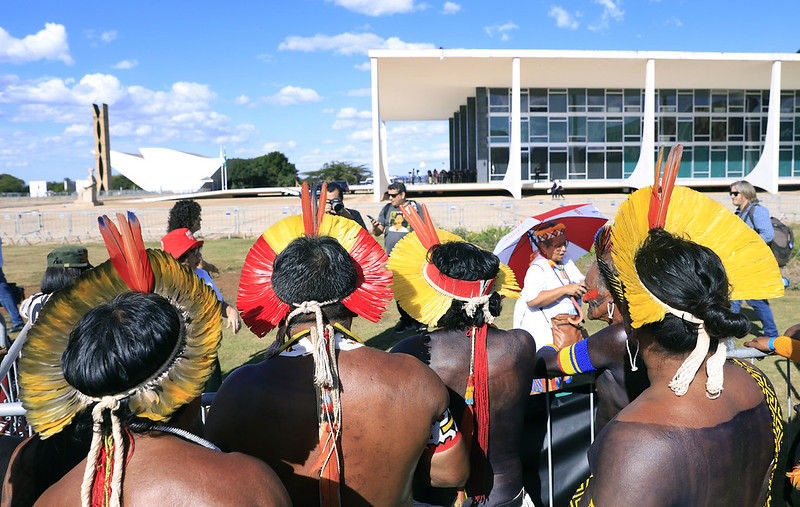
Justice Edson Fachin proposed, in votes cast at the Brazilian Federal Supreme Court (STF), a reinforcement to the protection of the territorial rights of indigenous peoples and the removal of obstacles to demarcation, including requirements related to the timeframe thesis. The analysis of the appeals that discuss these issues, however, was suspended this Tuesday (08/18) after justice Dias Toffoli requested more time to study the matter.
The judgments revolve around four lawsuits analyzed jointly and an appeal with general repercussions recognized under Topic 1,031, a precedent in which the STF granted the original character of indigenous territorial rights and the declaratory nature of demarcation.
Votes were cast on the motions for clarification of Extraordinary Appeal (RE) 1.017.365, which originated Topic 1,031, and the lawsuits that put into question Law No. 14,701/2023, which added the timeframe thesis to the legislation. The judgment has not yet been concluded, and thus Fachin’s proposals do not represent a new definitive decision by the STF.
Read more

What’s at stake
The timeframe thesis determines that indigenous peoples would only be entitled to the demarcation of the land they occupied on October 5th, 1988. The thesis does not take into account expulsions, forced removals, and other types of violence that led communities to abandon their territories.
In 2023, when judging on RE 1.017.365, the STF rejected the timeframe thesis and stated that indigenous territorial rights do not depend on the physical presence of said people on a given land in 1988 or the existence of a permanent physical conflict or judicial dispute on that date. The Court also acknowledged that demarcation merely declares an original right, rather than creating it.
In 2023, however, Congress passed Law No. 14,701, which added the timeframe thesis to legislation. In December 2025, the STF once again stated that indigenous territorial rights are fundamental and declared the main legal provisions related to the requirement of indigenous presence in 1988 to be unconstitutional. The new votes by justice Fachin refer to the rules established in that trial.
Indigenous rights cannot depend on conflict
One of the main aspects analyzed by Fachin is the so-called “persistent dispossession”, a situation where indigenous peoples were expelled from their territories and continued to claim their legal status.
The supreme court justice proposes a removal of the requirement for there to have been a permanent judicial dispute or physical conflict by 1988. He claims that this requirement disregards the historical violence suffered by indigenous peoples and the limitations imposed by the state protection system.
He proposes an analysis of the different forms of resistance of each people, including from anthropological studies carried out in the demarcation processes.
Vulnerability cannot be a reason to lose priority
Fachin also puts into question the adoption of the chronological order of claims as an exclusive criterion to organize demarcation processes. According to the justice, this rule could be a hindrance to the peoples that have faced the largest obstacles when accessing the State.
He proposes allowing the consideration of factors such as the risk to integrity of communities, the stage of processes, and the specific conditions of each territory.
The situation of isolated indigenous peoples makes the problem even more evident: since they lack regular contact with State authorities, they cannot be subjected toa logic that depends on an administrative request. A protocol-based queue would be inaccessible for these peoples.
Demarcation must continue to be the ruling factor
Another aspect of the votes refers to situations in which the State finds it impossible to carry out demarcation. According to Fachin, so-called “absolute impossibility” cannot be mistaken for administrative difficulty, political inconvenience, or preference for the interests of individuals.
The proposal is that Funai, when hearing affected communities, should assess whether there is an absolute impossibility. The creation of alternative territories should remain an exceptional element and not automatically replace demarcation.
Fachin also rejects rules that could lead communities to the end of the queue due to “invasions” or “repossessions”. According to the justice, this would create a sort of collective punishment against peoples that are already vulnerable from historical territorial conflicts.
Compensation cannot legitimize illegal occupations
Fachin further suggests a restriction on compensations to non-indigenous occupants of lands that are later recognized as indigenous. To receive reparations for the value of bare land, the occupant must have fair ownership and possession in good faith resulting from an apparently regular concession of rights carried out by public authorities.
The measure seeks to avoid having the State compensate people who have acquired public lands through invalid deeds or illegal occupations. At the same time, it preserves reparations for those who have been legitimately led by the State itself to believe in the validity of their ownership.
What happens now
The trial is still pending. Under RE 1.017.365, Fachin made his vote as a rapporteur of the motions for clarification. In the actions that question Law No. 14,701/2023, his vote is partially diverging from that of justice Gilmar Mendes.
Up until now, Fachin’s vote on Topic 1,031 was accompanied by justices Cristiano Zanin and Cármen Lúcia. In the actions on Law No. 14,701/2023, Gilmar Mendes’ vote was accompanied by justice Alexandre de Moraes; Zanin made a partially diverging vote, and the vote with a request for analysis time by Fachin was accompanied by Cármen Lúcia.
The full panel is yet to discuss the topics presented. Therefore, the changes described correspond to the proposals contained in Fachin’s vote, and not a new definitive decision by the Court.
There is more in dispute than the definition of demarcation criteria. The trial involves the very interpretation of article 231 of the Constitution and the effectiveness of territorial rights that the STF has already recognized as original and fundamental.