Understand the decision by the STJ that recognizes the May Crimes as a severe human rights violation
Court dismisses the five-year statute of limitations in a public civil lawsuit filed by the São Paulo State Prosecution Office and determined that São Paulo state courts should analyze the requests for accountability and reparations
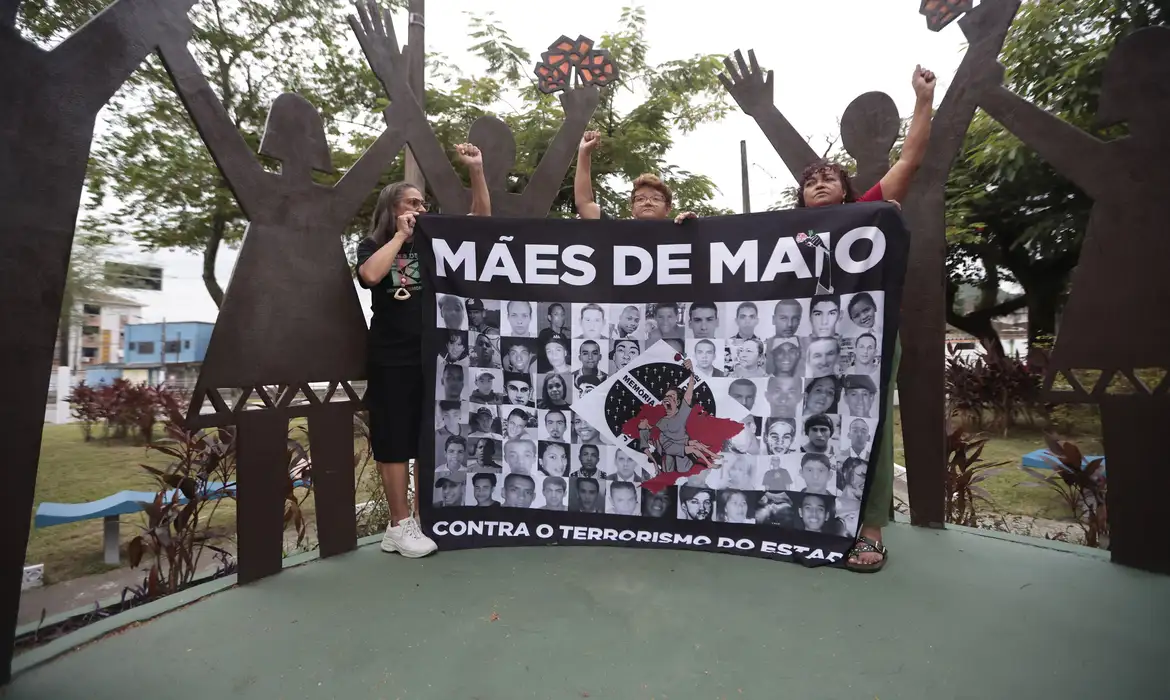 Paulo Pinto/Agência Brasil
Twenty years after the May Crimes, a decision by the Superior Court of Justice (STJ) opens a new path for the State of São Paulo to be held accountable for the severe human rights violations that occurred during the wave of violence that washed over the state in May 2006. On Wednesday (12th), the First Section of the court dismissed the five-year statute of limitations applied to a public civil lawsuit that seeks accountability for the State and reparations for victims and their relatives.
The lawsuit was filed by the São Paulo State Prosecution Office (MPSP) and seeks to hold the State accountable for the deaths that occurred in that period, as well as to secure individual and collective reparation measures. The São Paulo State Public Defender’s Office, which operates in the case as assistant counsel, resorted to the STJ against decisions by São Paulo state courts that had considered the lawsuit to be time-barred. Conectas and the Mães de Maio Independent Movement observed the case as amici curiae and defend that the May Crimes should be recognized as severe human rights violations.
With the decision, the case is now back at the São Paulo state courts, which shall analyze the merits of the lawsuit. This means a reexamination of facts and evidence, leading to a decision on whether the State is accountable and whether to grant the claims for reparation. Therefore, the STJ did not determine the payment of compensation or establish, at this stage, that the State of São Paulo is responsible. The decision prevents the case from being dismissed due to the passage of time before these issues are analyzed.
Read more

“The struggle is not over, but we will continue to push forward. However, what I want the most now, as a next step, is to see the State of São Paulo apologize for the absence taken from the heart of our family, our children”, says Débora Maria da Silva, founder of the Mães de Maio Independent Movement.
The decision is relevant for the protection of human rights since it acknowledges that the episodes known as the May Crimes, notable for deaths, claims of summary executions, forced disappearances, and investigative failures, should have a legal treatment compatible with the severity of the violations.
What did the STJ decide?
As a rule, actions for compensation against public authorities are subject to a five-year statute of limitations, as set out in Decree no. 20,910/1932. It was based on this term that the São Paulo courts had considered the public civil lawsuit filed by the state Prosecution Office as being time-barred.
At the STJ, however, the prevailing understanding was that this term cannot prevent the investigation, the accountability, and reparation in situations that involve severe human rights violations.
The rapporteur, justice Teodoro Silva Santos, listed the exceptional circumstances of the case: claims of summary executions, forced disappearances, possible participation or omission of state operatives, and severe failures in the ascertain of facts. The judge also took into account the commitments undertaken by Brazil in international human rights treaties and the case law of the Inter-American Court of Human Rights.
In his vote, Teodoro claimed that employing the statute of limitations in these cases could perpetuate impunity and contradict the duty of the State to ensure justice to victims. “The severity of the violations, the absence of effective accountability mechanisms and the systematic impact on vulnerable groups qualify these events as severe human rights violations.”
The justice also highlighted that the enforcement of a statute of limitations, in this type of case, could create a barrier to the investigation of facts and the reparation of victims. According to hum, the statute of limitations is incompatible with the duty to assure justice when severe human rights violations are involved.
What does it mean to dismiss the statute of limitations?
The statute of limitations, or time-barring, is the loss, due to the passage of time, of the possibility to claim a specific right or accountability in court, according to the terms established by law.
In the case of the May Crimes, the discussion was not only about how much time had passed since the deaths. The core matter was whether a deadline set for actions against public authorities could be enforced when allegations of severe human rights violations are involved and when the very delay by the State in investigating and holding parties accountable contributed to the lack of responses of the facts.
By dismissing the statute of limitations, the STJ allows the São Paulo judiciary to examine the requests presented in the public civil lawsuit. The decision, therefore, does not automatically establish that the State of São Paulo is responsible – but it makes sure this discussion can occur.
The understanding also matches international case law. In his vote, the rapporteur mentioned decisions by the Inter-American Court of Human Rights that recognize the need to prevent procedural obstacles from hindering investigations and reparations in cases of torture, extrajudicial executions, and forced disappearances.
What were the May Crimes?
Between May 12th and 21st, 2006, São Paulo experienced a sequence of attacks attributed to the Primeiro Comando da Capital (PCC) against law enforcement and public institutions. In response to that, a wave of violence reached mainly the State’s outskirts.
According to data presented by the São Paulo State Prosecution Office, 564 people were killed, 110 were injured and at least four people were the victims of forced disappearances. Investigations pointed to suspicions of summary executions and indiscriminate persecution, especially against young Black youth residing in the city outskirts.
The dimension of the deaths, the similarity between different cases and the complaints of participation or omission by public operatives led human rights organizations and relatives to question the actions of authorities in the investigation.
Conectas has highlighted that the May Crimes expose a pattern of state violence that disproportionately affected Black youth in the outskirts and that, two decades later, the absence of State response continues to be a core part of the problem.
Why is the public civil lawsuit important?
The public civil lawsuit was filed by the São Paulo State Prosecution Office in 2018 and seeks to hold the State of São Paulo accountable for the violations that occurred during the May Crimes. Its goals include a recognition of the violations and the adoption of measures of individual and collective reparation.
The claims presented include compensation of 136,000 BRL for each family of a fatal victim and 68,000 BRL for wounded survivors, in addition to psychological counseling and a formal apology from the State.
More than a discussion on compensation, the process involves rights related to truth, memory, justice, reparation and non-repetition. These principles are part of what is referred to as transition justice and, according to Conectas and the Mães de Maio Independent Movement, should also be considered in the face of severe violations perpetrated during the democratic period.
Severe violations may also occur in a democracy
One of the points highlighted during the trial was the very need to recognize severe human rights violations occurred during the democratic period.
Justice Paulo Sérgio Domingues, who voted with the rapporteur, highlighted the risk of interpreting the absence of precedent on severe violations that occurred after the redemocratization as a sign that they do not occur.
“It would be wonderful, but it doesn’t seem to be our reality to me”, the justice stated, by rejecting the idea that democracy, by itself, would prevent the occurrence of severe human rights violations. To Paulo Sérgio, the fact that violations do not reach courts could also reveal flaws in the State’s capacity to investigate them. “They do occur, but are not investigated, and hence do not arrive here, which is very bad.”
The statement matters because it displaces the discussion: the absence of court decisions on severe violations during democracy does not necessarily indicate an absence of these violations. It could also mean that they were not properly investigated or that there were obstacles in reaching the Judiciary.
When concluding his vote, the justice defended that time should not become an obstacle preventing the analysis of violations of this magnitude. “It is in the interest of Democratic Rule of Law that we proceed, that we allow the analysis of the merits of the matter, dismissing the statute of limitations.”
The role of international human rights treaties
Another important aspect of the decision is the use of international standards to interpret Brazilian law. The rapporteur cited the American Convention on Human Rights, known as the Pact of San José, Costa Rica, and precedents from the Inter-American Court of Human Rights. He also mentioned Recommendation No. 123/2022 of the National Council of Justice (CNJ), which instructs the Brazilian judiciary to observe international human rights treaties and the case law of the Inter-American Court.
For Teodoro Silva Santos, the so-called “control of conventionality”, i.e. the analysis of the compatibility of domestic rules and practices with international commitments undertaken by Brazil, reinforces the State’s obligation to protect fundamental rights. “This alignment of case law, carried out in the case at hand through the application of the Inter-American Court’s decision-making standards, reaffirms the Judiciary’s role as an instrument for guaranteeing human dignity and as a partner in the consolidation of fundamental rights on a global scale.”
The case has already reached the international system
The dispute surrounding the “May Crimes” has also extended beyond Brazil’s borders. Human rights organizations and victims’ families turned to the Inter-American system due to the difficulties in conducting investigations and ensuring accountability within Brazil.
In 2021, Conectas and other organizations filed a petition with the Inter-American Commission on Human Rights (IACHR), denouncing the Brazilian State’s lack of response regarding the disappearances that occurred in the context of the May Crimes. The organization had previously appealed to the IACHR in 2009, alongside the victims’ families.
The case was also brought before the Commission by the Public Defender’s Office in 2015. According to Conectas, the internationalization of the dispute stems from the inadequate responses provided by Brazilian authorities over the years.
This international dimension underscores the significance of the Superior Court of Justice (STJ) ruling: the May Crimes are not merely a matter of domestic civil liability, but a case involving obligations Brazil has assumed under the international human rights protection system.
The federalization of some of the investigations
This week’s decision adds to another significant legal milestone regarding the May Crimes. In 2022, the Superior Court of Justice (STJ) ruled to transfer the investigations into the deaths at Parque Bristol, São Paulo, to federal jurisdiction, acknowledging flaws in the inquiry conducted by state authorities. The request for federalization had been submitted to the Prosecutor General’s Office in 2009 by Conectas, alongside the victims’ families.
This measure allowed the investigation to be shifted to the federal level, involving the Federal Police and the Federal Court system. The federalization process exemplifies how the efforts of families and human rights organizations were crucial in keeping these cases in the public eye and seeking alternatives in the face of inadequate responses from state authorities.
What happens now?
With the statute of limitations dismissed, the case returns to the São Paulo courts. It will be up to the trial court to examine the merits of the public civil action and rule on the requests submitted by the Public Prosecution Office.
This means there will still be a judicial phase to assess allegations regarding the State’s responsibility and claims for reparation. The STJ’s decision does not amount to a ruling against the São Paulo government. What changes is that the proceedings can no longer be dismissed simply on the grounds that more than five years have elapsed since the events in question. The São Paulo courts must now examine the substance of the lawsuit, the evidence, and the claims for reparation that have been presented.
The work of Conectas
This week’s decision follows two decades of mobilization by victims’ families and human rights organizations seeking truth, justice, and reparation.
In partnership with the Mães de Maio Independent Movement, Conectas has been active regarding the May Crimes since 2009, when it submitted a request to the Prosecutor General’s Office (PGR) to federalize the investigation into the Parque Bristol massacre, one of the episodes linked to the May Crimes. In 2016, the PGR forwarded the request to the Superior Court of Justice (STJ), and in 2022, the court ruled in favor of federalizing the investigation.
In the proceedings that reached the First Section for judgment, Conectas and the Mães de Maio Independent Movement also sought to participate as amici curiae. The arguments offered included recognizing the May Crimes as severe human rights violations, the non-applicability of statutes of limitations, the application of transitional justice principles, and the need for both individual and collective reparation.
The recognition of the severity of these violations is the result of a two-decade struggle by the families, who have sought investigations into their loved ones’ deaths and accountability on the part of the State.
Lawyer Caroline Leal, strategic litigation advisor at Conectas, considers the ruling a legal and social milestone for Brazilian democracy. According to her, the Superior Court of Justice (STJ) decision sets an important precedent for cases involving grave human rights violations marked by racism and structural violence, by preventing the passage of time from being used as an obstacle to holding the State accountable.
“This is a historic achievement for human rights, the result of the struggle of the Mães de Maio Independent Movement, which, despite the grief, pain, and institutional violence they endured, never gave up seeking justice,” she states.
A decision that does not end the fight for justice
The STJ’s decision does not resolve the May Crimes. It does not, in itself, clarify who was responsible for the deaths, determine compensation, or establish all the reparation measures the State must adopt. However, it prevents the passage of time from being used to prevent the examination of these issues. By acknowledging the severity of the violations and ruling out the statute of limitations, the court reaffirms that the duty to investigate, hold those responsible accountable, and provide reparations does not simply vanish because the events took place two decades ago.
Cases in the Inter-American Human Rights System
The fight for justice regarding the May Crimes also reached the Inter-American Human Rights System through three cases involving Conectas: the Parque Bristol Massacre, submitted to the IACHR by Conectas and the victims’ families in 2009. The case reached the Inter-American Court in 2025 after the IACHR recognized rights violations and Brazil’s failure to comply with its recommendations; the Baixada Santista Executions, a complaint filed in 2015 by the São Paulo Public Defender’s Office and the Mães de Maio Movement, with support from Conectas. The case involves nine deaths and was admitted by the IACHR in 2021; and Enforced Disappearances, a complaint filed in 2021 by Conectas, the São Paulo Public Defender’s Office, and the Mães de Maio Movement regarding four individuals who disappeared during the May Crimes.
May Crimes: understand the judicial trajectory of the case
2006 | May Crimes
A wave of violence in São Paulo leaves hundreds dead, including cases claimed to be summary executions, in addition to disappearances and reports of participation or omission by public operatives.
2018 | Public civil lawsuit
The São Paulo State Prosecution Office (MPSP) files a lawsuit against the State of São Paulo with requests for accountability and reparation to victims and family members.
2020 | The case arrives at the STJ
The case is referred to the Superior Court of Justice, where the possibility of the action being time-barred begins to be discussed.
2021 – 2022 | Appeals and delays
The São Paulo State Public Defender’s Office resorts to the STJ. The judgment at the Second Panel is successively delayed.
2024 | Special Appeal
The STJ takes cognizance of the appeal by the Public Defender’s Office and determines it should be processed as a Special Appeal. In December, the Second Panel refers the case to the First Panel.
2024 | Mães de Maio and Conectas enter the case
Conectas and the Mães de Maio Independent Movement begin to act as amici curiae, contributing to the trial.
2025 | The trial begins
Rapporteur justice Teodoro Silva Santos votes for the partial granting of the appeal. Justice Marco Aurélio Bellize asks for more time to analyze the matter.
March 2026 | New request for time
After the vote by Bellizze, the rapporteur asks for regimental time for analysis and the judgment is once again interrupted.
August 12th, 2026 | STJ Decision
The majority of the First Section partially grants the appeal of the Public Defender’s Office and determines that the case should be returned to São Paulo state courts.
Next stage | São Paulo state courts
With the statute of limitations ruled out, São Paulo courts must analyze the merits of the lawsuit and the requests for accountability and reparation. The decision by the STJ does not yet mean the State is sentenced.


