How to expand infrastructure in South America without relinquishing rights
Civil society defends that the IDB’s South Connection Program should incorporate, since its planning stage, transparency, social participation, socio-environmental protection, and respect towards human and socio-environmental rights, in addition to criteria to avoid violations associated with major infrastructure projects
 Aerial view of trucks queueing along the BR163 highway, in Moraes Almeida district, Itaituba, Para state, Brazil, in the Amazon rainforest, on September 11, 2019. The BR230 and BR163 are major transport routes in Brazil that have played a key role in the development and destruction of the world's largest rainforest, now being ravaged by fires. (Photo by NELSON ALMEIDA / AFP)
What role should the Inter-American Development Bank (IDB) play in building a new regional integration model in South America? The issue involves not only facilitating cross-border infrastructure but also the upholding of human rights, ensuring environmental sustainability and climate resilience, and adopting best practices regarding transparency and social participation.
What experiences and best practices should guide the Bank’s actions in this process? And how can integration among South American countries be expanded without reproducing inequalities or exacerbating rights violations?
These questions guided the workshop “Inter-American Development Bank (IDB) South Connection Program: Opportunities and Challenges for Building Sustainable, Inclusive, and Resilient Infrastructure in South America,” held in July in Brasília (DF).
Read more

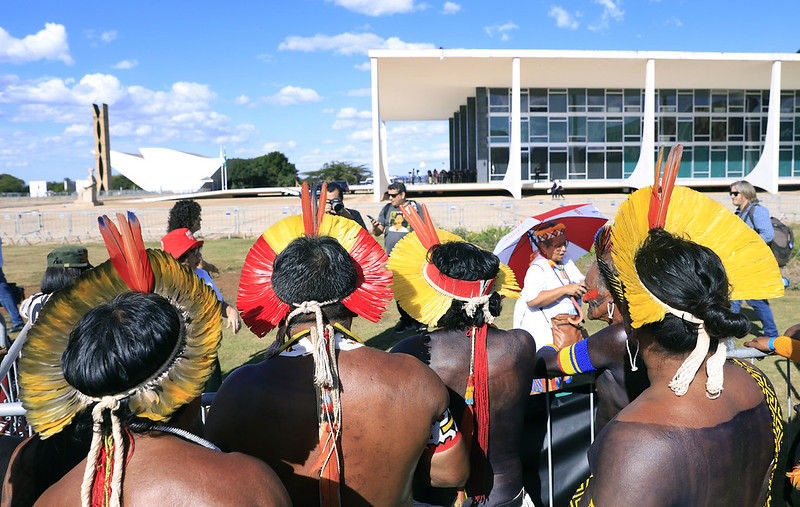
Organized by Conectas, the Bank Information Center (BIC), and the Working Group on Infrastructure and Socio-environmental Justice (GT Infra), the meeting brought together representatives from the IDB, public agencies, development banks, civil society organizations, Indigenous peoples, Afro-descendant communities, universities, and research centers.
The goal was to discuss ways for the South Connection Program to incorporate criteria regarding transparency, social participation, and socio-environmental protection from the design stage onward, thereby avoiding the repetition of flaws observed in previous regional integration initiatives.
South Connection Program
Launched by the IDB Group in 2025, the South Connection Program attempts to strengthen regional integration through investments in transportation infrastructure, energy integration, and digital connectivity. The initiative also envisions actions aimed at regulatory modernization, institutional strengthening, and facilitating the movement of goods, services, and data among South American countries. The bank emphasizes that this is a living program — not one based on a rigid “corridor” model — and that project viability will be assessed using social, environmental, and economic criteria, rather than solely technical and financial ones. However, the program was designed without the participation of civil society or the traditional communities that could be affected by its projects, bearing a strong resemblance to the South American Integration Routes program, an initiative presented by the Brazilian government that focuses on commodity exports.
During the workshop, Renata Vargas Amaral, coordinator of the South Connection Program, presented the initiative’s key pillars. According to her, the program is based on the assessment that South America still faces long-standing limitations regarding connectivity and economic integration. The strategy is organized around three priorities: expanding physical and digital connectivity; improving logistics and trade facilitation; and strengthening institutional capacities and regulatory frameworks. Social and environmental sustainability serves as a cross-cutting principle across these pillars.
Socio-environmental impacts
Participants acknowledged the program’s potential to address historical infrastructure deficits in the region but emphasized that investments of this scale must consider, from the initial planning stages, the impacts on the territories and populations directly affected. The lack of transparency and public participation in the project’s design was also highlighted as a shortcoming that the IDB needs to address in the upcoming stages.
The discussion revisited past regional integration experiences in Latin America, such as IIRSA (2000–2011) and COSIPLAN. These initiatives demonstrate that major infrastructure projects can trigger serious socio-environmental conflicts when they fail to incorporate effective mechanisms for transparency, the assessment of socio-environmental and cumulative impacts, and public participation. This includes free, prior, and informed consultation with Indigenous peoples and other traditional communities, as well as consideration of infrastructure needs aimed at improving the quality of life for local communities.
An internal IDB assessment of IIRSA concluded that it was necessary to look “beyond the construction work” itself, incorporating logistics and regulatory issues — and, above all, social and territorial impacts — into regional integration efforts. For the workshop participants, these lessons should guide the governance of the South Connection Program from the very beginning of its implementation.
The workshop brought together around one hundred participants, including representatives from the IDB and its teams specializing in infrastructure, transport, and sustainability, as well as public agencies, universities, international bodies, and Indigenous, quilombola, and civil society organizations from Brazil, Bolivia, Peru, Ecuador, and Colombia.
Throughout the discussions, participants shared experiences from past regional integration projects and debated alternatives to strengthen territorial governance, support community-based infrastructure, and establish permanent dialog mechanisms among the IDB, Indigenous peoples, Afro-descendant communities, civil society organizations, and other stakeholders involved in the program’s implementation.
A key consensus reached at the meeting was the need to rethink the conventional logic of infrastructure planning: a corridor is not synonymous with a highway. Participants advocated for a multimodal approach that prioritizes waterways, railways, and other alternatives over road construction, given the greater territorial impact the latter have on Amazonian ecosystems and territories.
Undertakings
The proposal is to view infrastructure not merely as a set of projects aimed at economic integration, but as a strategic tool to strengthen ecological connectivity, promote climate change adaptation, support socio-biodiversity economies, and ensure respect for the rights of Indigenous peoples and traditional communities.
The undertakings made by the Bank during the event include:
- submitting the proposal for the South Connection Program’s Stakeholder Engagement Plan, with a timeframe for receiving substantive input from civil society;
- establishing an expanded Advisory Panel featuring participation from civil society, Indigenous peoples, Afro-descendant communities, the private sector, and academia;
- developing transparent criteria for selecting and prioritizing South Connection Program projects, incorporating social and environmental feasibility standards.
The discussion also reinforced the perspective that regional integration should not be measured solely by the expansion of physical infrastructure or the advancement of connectivity between countries. For the participating organizations, the success of the South Connection Program will depend on its ability to combine sustainable development, socio-environmental justice, and respect for human rights, while ensuring the effective participation of populations living in the territories affected by the investments.