Trans Visibility: a drop in the number of murders does not mean less violence, ANTRA report warns
On National Trans Visibility Day, a report by the association of travestis and transsexual people shows a drop in the number of murders, but warns of underreporting; a linguistics researcher stresses there has been an increase in “anti-gender offensives”
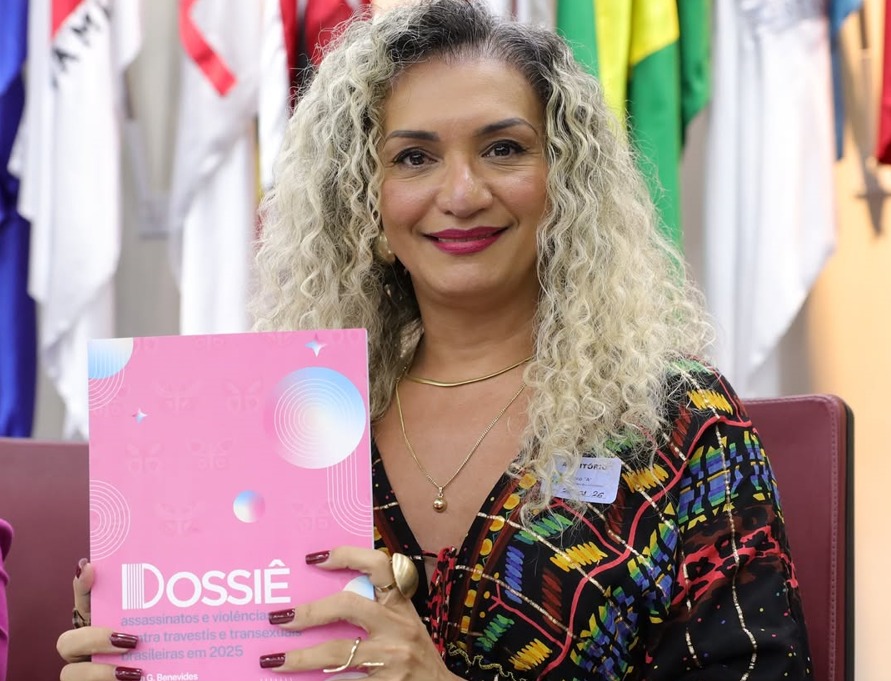 A presidente da Antra, Bruna Benevides, com nova edição do dossiê da associação. Foto: Reprodução/Instagram
On the eve of National Trans Visibility Day, celebrated on 29 January, the National Association of Travestis and Transsexual People (ANTRA) released its 2026 Report, a compilation of data on murders and other forms of violence against trans people in Brazil in 2025. The document points to a drop in the number of murders, but indicates that the reduction does not necessarily reflect improved living conditions or the guarantee of rights for this population.
According to the survey, for the 18th consecutive year, Brazil is the country that kills the most trans people in the world. In 2025, 80 murders were recorded, compared to 122 in the previous year—a drop of 34%. ANTRA believes the data should be interpreted with caution: the organization says the decrease is linked to an increase in underreporting and institutional erasure of violence, rather than to structural changes in the context of exclusion.
“Fewer recorded incidents do not mean less violence. On the contrary, there is an intense movement to institutionalize transphobia. And we live in a country of paradox,” said Bruna Benevides, ANTRA President of ANTRA and a Conectas board member, during the event to launch the research.
Read more

Underreporting and institutional erasure
The report highlights that the lack of systematized official data on the trans population continues to be one of the key obstacles to tackling violence. Without information produced and consolidated by the State, it is difficult to formulate public policies, hold aggressors accountable, and monitor rights.
Since 2011, ANTRA has served as one of the main sources for monitoring these cases in Brazil, based on data collected from the press, direct reports, and support networks. The organization believes that the State’s failure to produce data is not neutral: it is a political choice that contributes to invisibility and the perpetuation of a cycle of violations.
Who are the victims
An analysis of the victims’ profiles reveals overlapping inequalities. Of the total number of murders recorded, 97% of the victims were travestis and trans women. The majority were under 35 years old, were Black, and living in poverty. The report also shows that many of these people were pushed into sex work as a direct consequence of exclusion from the education system and formal employment.
Another noteworthy piece of data is the spread of violence into inland areas. In 2025, 67.5% of crimes occurred in cities outside the main urban areas, where access to safeguarding networks, public services, and reporting mechanisms tends to be even more limited.
Online hatred and the normalization of transphobia
In addition to physical violence, the report also highlights the growth of anti-trans hatred on social media. Data from the Explana 2.0 survey, conducted by data_labe and included in the report, show that platforms such as Instagram, Facebook, and X account for a large proportion of the spread of fake news and discriminatory discourse against trans people.
Among those interviewed, 93.9% reported having encountered transphobic content on social media, and 55% said they had been deeply affected by this type of violence. According to the study, over half the reported content is not removed and remains online, which contributes to the normalization of transphobia and to violence being reproduced beyond the digital environment.
Language, politics, and the fight for rights
To understand how this type of violence is also consolidated at the symbolic and institutional levels, the report draws on analyses in the recently published book Guerras antigênero (Mórula Editorial), by Danillo Silva, PhD in applied linguistics and professor at the Federal Institute of Alagoas (IFAL). His work examines how language has become central to political dispute in contemporary Brazil, particularly around issues related to gender, sexuality, and human rights.
According to the author, “a significant part of what intellectual production in the feminist field refers to as ‘anti-gender offensives’ corresponds to political initiatives that seek to neutralize, reverse, and/or criminalize advances in the promotion of citizenship for trans people in Brazil,” a process that ultimately “embeds gender-based violence in different institutional practices, such as legislation and public policies.” Silva believes these dynamics do not operate only in explicit ways, but are rooted in the everyday functioning of the State.
In this sense, the researcher states that “wars against the production of citizenship based on gender and sexuality emerge, primarily, through strategies that operate below the radar”. He believes it is a matter of naturalizing discursive constructions that lead to the concrete effects of violence and exclusion. Expressions like “protection of childhood,” “defense of the family,” “gender ideology,” “religious freedom,” and “early sexualization” “function as signs that trigger anti-gender forces,” by infiltrating State discourse with “conservative and anti-democratic rationalities, that run counter to constitutional values and human rights.”
This perspective helps explain how the scenario described in ANTRA’s report is not limited to isolated incidents of violence but is embedded in a broader context of political dispute, in which the production of citizenship based on gender and sexuality is systematically questioned, undermined, and, in many cases, institutionally challenged.
What visibility means
Given the circumstances, ANTRA emphasizes that National Trans Visibility Day cannot be reduced to a symbolic moment. The report argues for the need for structural public policies, such as the regulation of digital platforms, the investigation of organized networks that spread hate, the implementation of quotas for trans people in universities and civil service examinations, the guarantee of the use of social names across all State services, and the recognition of data produced by civil society.
The organization states that true visibility is more than the occupation of certain spaces—it is linked to a reduction in violence, effective access to rights, and the Brazilian State’s commitment to life, dignity, and full citizenship for trans people.