São Paulo State Public Defender’s Office celebrates 20 years of key work in the defense of human rights
The institution expanded access to justice, strengthened specialized centers and became consolidated as a key figure in structural litigation involving the prison system and state violence
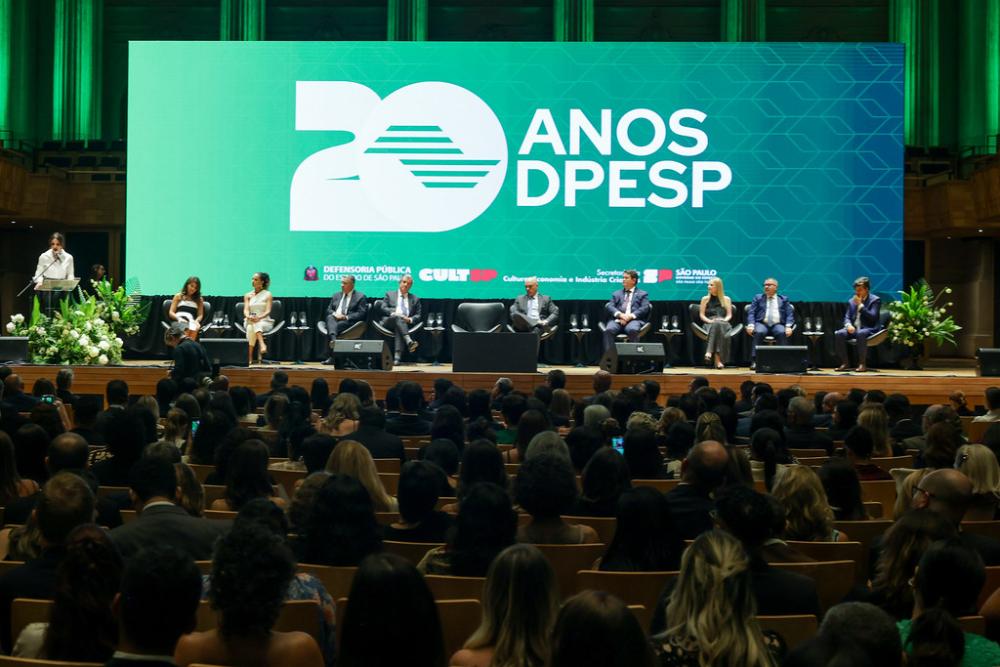
The São Paulo State Public Defender’s Office is celebrating 20 years of activity this January. Over the course of two decades, the institution structured itself and grew enough to be present where people need it the most, both in the capital city and in the countryside, becoming consolidated as one of the most important structures of the Brazilian justice system.
Though determined in the 1988 Federal Constitution, the São Paulo State Public Defender’s Office was created only in 2006, through Complementary State Law no. 988, after an intense mobilization by civil society. Compared to other states, São Paulo was one of the last states to implement the body. Currently, the DPE-SP is the largest Public Defender’s Office in the country and offers services throughout state territory, working on cases under State Justice jurisdiction, concentrating the most legal cases faced by the population.
Over its trajectory, the institution expanded its territorial presence, consolidated its functional and administrative autonomy, and strengthened specialized centers that carry out a key role in fighting rights violations. This includes the Incarceration Situation Center, the Citizenship and Human Rights Center and the Childhood and Youth Center, responsible for strategic legal work in topics with social and institutional impact.
Read more


The São Paulo Public Defender’s Office became consolidated as a relevant entity in the control of state activity, with emphasis on its work in the prison system and in public safety lawsuits. The institution has a key role in protecting the right to public demonstrations, the prevention of torture, and the accountability of the State for severe human rights violations. In this context, the General Ombudsman’s Office, with participation of civil society, constitutes one of the main mechanisms for the hearing, transparency, and social control of the institution.
Strategic litigations and joint work with Conectas
The partnership between Conectas Direitos Humanos and the São Paulo State Public Defender’s Office, has developed itself in strategic litigation towards the protection of human rights and the fight against structural violations perpetrated by the State.
One of the main examples of this cooperation is ADPF 347, pending before the Federal Supreme Court. Proposed in 2015 by the Socialism and Liberty Party (PSOL), the lawsuit calls for the recognition of the “institutional state of affairs” of the Brazilian prison system, inspired by a precedent from the Colombian Constitutional Court.
The joint work also extends itself to the case known as the Crimes of May, known as the slaughter that occurred in the state of São Paulo between May 12th and 21st, 2006, which resulted in over 560 deaths, in addition to people injured and victims of forced disappearances. After nearly 20 years, relatives and social movements continue to fight so that the case won’t remain unanswered. In a partnership with the Independent Movement “Mães de Maio” and Conectas, the Public Defender’s Office works for the effective accountability of the State and to implement full reparation policies for the victims and their relatives.
Another case of a joint effort between the institutions was the public civil lawsuit calling for the Justice system to obligate the São Paulo State Government to install body cameras on the police officers working on the Escudo Raid.
More recently, the Citizenship and Human Rights Center and the Childhood and Youth Center of the Defender’s Office, together with Conectas, filed a complaint before the Inter-American Commission on Human Rights, of the Organization of American States (OAS), due to the severe human rights violations that occurred in the Escudo (2023) and Verão (2024) raids, carried out in the Baixada Santista region. The petition gathers testimonies from relatives and surviving victims, in addition to official documents and records, pointing out that, when adding both operations, at least 84 people would have been killed.