Indigenous people and indigenists warn of the urgent need to remove invaders from the Cachoeira Seca Indigenous Land (Pará)
Land regularization has been pending for almost a decade. The territory of the recently contacted Arara people has been targeted by invasions and deforestation and is facing a health crisis
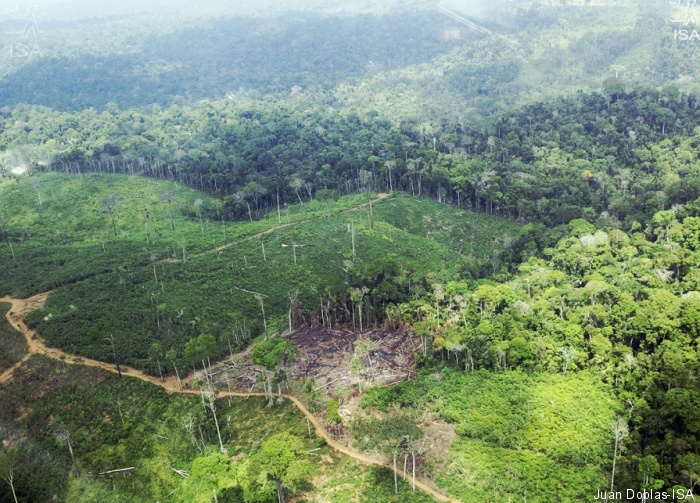 Área desmatada na Terra Indígena Cachoeira seca do Iriri. Foto: Juan Doblas/Ascom ISA
In a technical note released today (17) Indigenous organizations and indigenists warn of the precarious situation of the Arara Indigenous people who live on the Cachoeira Seca Indigenous Territory, in the middle Xingu region, in Pará. From 2023 to 2024, deforestation of the Cachoeira Seca Indigenous Territory leapt from 795 hectares to 1,149 hectares—a 45% increase. This rise is in sharp contrast to the regional trend: the Xingu basin saw deforestation decrease by 46%, and the Legal Amazon by 30.6%. According to data from the Sirad X monitoring system at the Socioenvironmental Institute (Isa), Cachoeira Seca is one of the few Indigenous lands in the country where destruction is advancing, ranking 4th in the overall Amazon classification system.
The document contains an analysis of the urgent need to move forward with land regularization of this territory, stressing the increase in deforestation in the area, in contrast with the decrease seen in other Indigenous Territories in the Xingu basin. While the Legal Amazon and the Xingu basin are celebrating historic declines, deforestation rates on the Arara territory run counter to this trend, with devastation on the rise. The document identifies the presence of invaders and deforestation as causes of a crisis that combines territorial insecurity and a psychosocial health crisis among the Indigenous people.
Overdue regularization drives invasions
Recent government efforts have resulted in the removal of intruders from other important Indigenous Territories in the region, such as Apyterewa, Trincheira-Bacajá and Ituna Itatá—actions that have sharply reduced deforestation in these areas. However, the same level of commitment has yet to be seen in Cachoeira Seca. The territory is not on the invader-removal list of the ADPF 709 (Allegation of Non-compliance with a Fundamental Precept) and there is no prospect of regularization being completed by the Ministry of Justice, the Ministry of Indigenous Peoples, or Funai. The delay in regularization encourages new intruders and the suffering of the Arara people is exacerbated by territorial insecurity.
Read more


The situation was made worse by the construction of the Belo Monte hydroelectric plant, which should have been preceded by land-regularization measures and territorial safeguarding. To this day—13 years after the installation license was granted—these measures have not been implemented. The terms that have not been met are precisely the ones that were designed to prevent invasions and deforestation on the Indigenous lands impacted by the construction.
The legacy of forced contact
The vulnerability of the Cachoeira Seca Indigenous Land is a historical debt. The Arara people (who refer to themselves as the Ugoro’gmó) came into more frequent contact with the surrounding population in 1987, after their dramatic resistance to the construction of the Trans-Amazonian Highway (BR-230), which cut through their traditional territory.
Decades after the BR-230, another federal project—the Belo Monte hydroelectric plant—once again destabilized their precarious territorial security. Completing regularization of all the affected Indigenous Territories was one of the conditions of the plant´s licensing, but at Cachoeira Seca the legal process for the removal of occupiers never even began. The state’s omission meant new invaders were allowed to continue to enter the territory.
Cumulative deforestation on the Indigenous Territory had surpassed 68,777 hectares by July 2025, i.e., 9.35% of the total area. Invasions are made possible by opening up illegal roads used to steal timber. Since 2018, monitoring of the Xingu+ Network has mapped 586 kilometers of these roads, with the main village (Iriri) now less than 30km from the invaded area. The high incidence of fires is also a threat: the burned area almost doubled in 2023 (11,625 hectares) compared with 2022, reflecting land occupation for raising cattle and the consolidation of deforested areas.
Mental health crisis
The slow pace in resolving land issues and the profound impacts of Belo Monte have caused intense and severe suffering among the Arara people. Professionals classify the situation as an actual mental health crisis.
A letter from the Bem Viver Network of Cachoeira Seca reported illness and psychological suffering that have led to a series of deaths under painful circumstances. In 2023 and 2025, the deaths of leaders and young people in episodes associated with alcohol consumption were registered. Despite the severity of the situation, the Belo Monte corporation has refused to provide support for health services, repeatedly stating: “we can see no causal link” between the hardships of the Arara people and the venture.
Future threats and urgent recommendations
The already tense scenario could be worsened by the imminent paving of the Medicilândia-Rurópolis stretch of the BR-230. According to impact studies, this project will increase land values and encourage illegal occupation, intensifying conflicts in the area, as secondary roads already cross the Cachoeira Seca Indigenous Territory. The Indigenous Territory is deemed strategic because it marks the north-western border of the Xingu area’s protected ecological corridor, absorbing pressures coming from the Trans-Amazonian Highway.
The organizations signing the technical note–Articulation of the Indigenous Peoples of Brazil (Apib), Coordination of Indigenous Organizations of the Brazilian Amazon (Coiab), Observatory of Isolated and Recently Contacted Indigenous Peoples (Opi), the Socioenvironmental Institute (Isa), Conectas, and the Indigenous Missionary Council (Cimi)–make a series of recommendations to fortify security on the Cachoeira Seca Indigenous Territory.
The following are of particular interest:
- The immediate presentation of a schedule by Funai for completing the removal of invaders from the Cachoeira Seca Indigenous Territory.
- The definition of emergency actions by the Federal Police, Ibama, and Funai to prevent illegal logging and the expansion of roads.
- That the completion of the land-regularization process for the Indigenous Territory be a condition for starting paving works on the BR230.
- An investigation by the Federal Public Ministry (MPF) into current land grabbing and invasions.