2025 in focus: how Conectas addressed human rights violations in a pivotal year
Conectas highlights key developments in the field of human rights throughout the year: see below
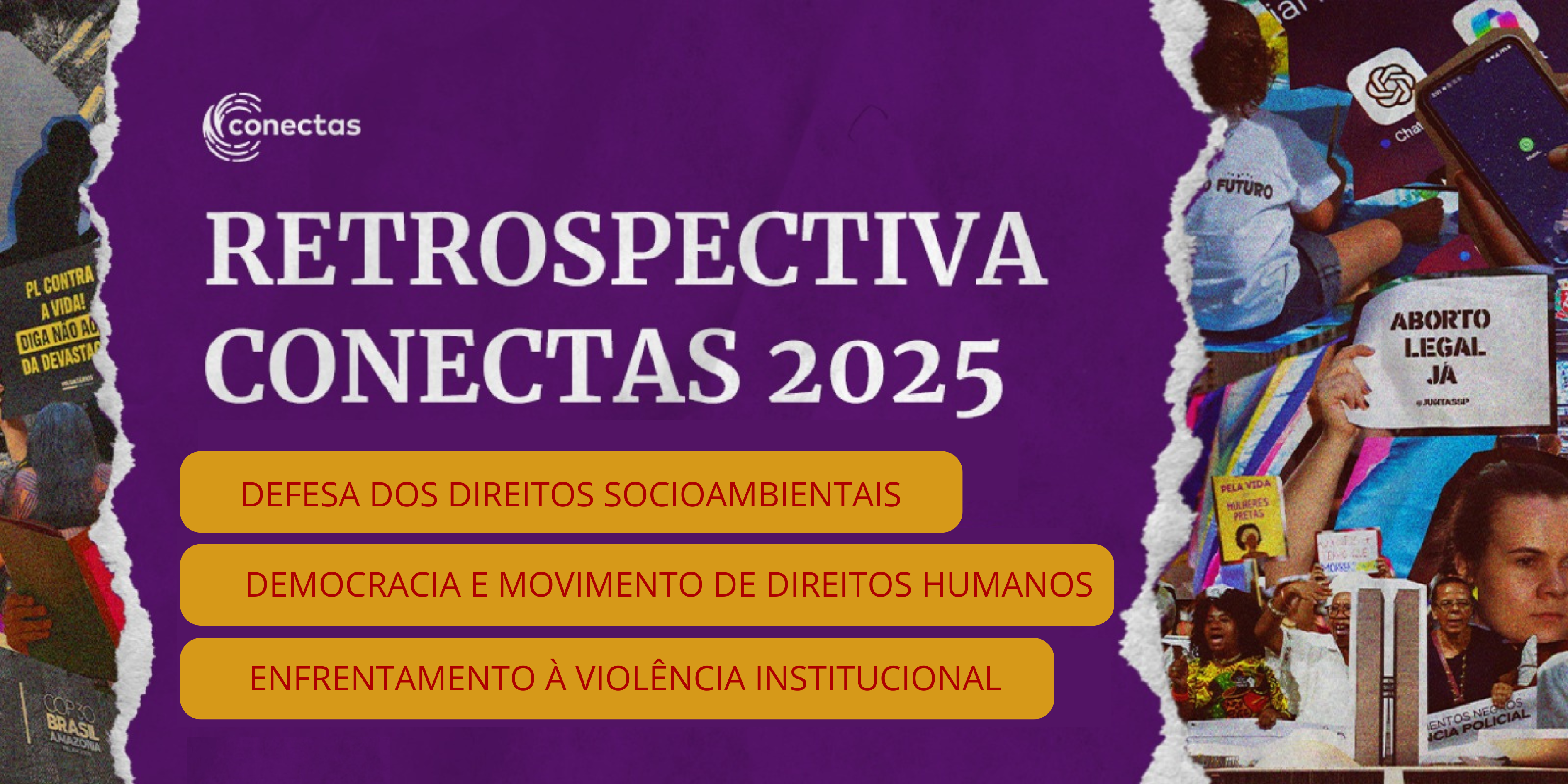
In 2025, Conectas Human Rights carried out its work in a context marked by threats to democracy, persistent institutional violence and a worsening climate emergency—impacts that disproportionately affect historically vulnerable communities.
In the face of this situation, the organization combined strategic litigation, policy advocacy, and national and international coordination to address human rights violations in Brazil and the Global South.
This retrospective is a collection of some of the key milestones of our work this year and there is still much more to share with you. A comprehensive overview of our activities will be provided in the organization’s Annual Report, to be released in the first quarter of 2026.
Read more


Strengthening democracy: attention and resilience in challenging times
The defense of democracy was a central pillar of Conectas’ work this year. A historic milestone was the conviction of those responsible for the attempted coup against the democratic rule of law, decided by the Federal Supreme Court (STF), demonstrating the strength of Brazil’s democratic institutions.
This defense is also expressed through listening to and walking side by side with social movements. In this spirit, Conectas stood alongside more than 100,000 Black women at the Black Women’s March, marching for a shared vision of democracy, racial justice, and historical reparation.
Another key issue was the regulation of artificial intelligence, given the risks involved in the indiscriminate use of surveillance technology, such as facial recognition. Conectas raised concerns at the UN about the potential exacerbation of violations against people from historically marginalized groups and published a report outlining guiding principles to promote the responsible development, deployment, and use of this technology. In partnership with other organizations, Conectas also organized a meeting between activists and experts in this area and the UN Special Rapporteur on the right to freedom of peaceful assembly and association.
In 2025, Conectas also played a key role in strengthening the human rights movement and in building networks and national and international partnerships, by convening meetings to bring together activists from different areas and countries, with the aim of deepening the exchange of experiences on democracy, justice, the fight against racism, socioenvironmental rights, as well as promoting joint forms of mobilization.
At the international level, the organization also participated in UN and the Inter-American System forums, reporting on omissions by the Brazilian State, particularly with regard to the rights of the Indigenous peoples, and stressing the need for a plural, participatory democracy protected from disinformation.
Institutional violence and structural racism: accountability to prevent recurrence
In 2025, police violence and structural racism were at the center of public debate. The Penha Massacre in Rio de Janeiro, considered to be the largest police massacre in the history of the state, prompted national and international mobilization. Conectas triggered UN mechanisms and accompanied missions by human rights groups, demanding independent investigations, accountability, and reparation for the families.
Another important milestone was the conclusion of the trial of the ADPF of the Favelas (ADPF 635), which set out measures to reduce police lethality, such as the use of cameras on patrol cars and police officers’ uniforms. We continue to monitor compliance with the ruling and to report instances of non-compliance in future episodes of violence.
The Federal Supreme Court also acknowledged the existence of structural racism, and ordered a national plan be put together to fight racism. This was an important step that was closely monitored by Conectas who acted as amicus curiae in the case (ADPF 973).
The fight for justice continued to underpin our work. We informed the international community of the urgent need to hold the São Paulo state government and the Brazilian State accountable for police violence. Our actions included advocating for the use of body cameras by the police forces and for improvements in external oversight of police activity by the Public Prosecutor’s Office. In partnership with the São Paulo State Public Defender’s Office, we reported to the Inter-American Commission on Human Rights on the lack of accountability in the cases of Operation Shield (Escudo) and Operation Summer (Verão). We also carried out a mission to the UN Human Rights Council, calling for the accountability of the State and its agents for the death of Marco Aurélio and highlighting the inaction of the São Paulo Public Prosecutor’s Office.
In this vein, we highlight the project “Strengthening the Reach and Impact of Human Rights Movements in Brazil”, spanning two years, in conjunction with the Independent Mothers of May Movement and CAAF/UNIFESP, as well as family movements from Bahia, Ceará, and Rio de Janeiro. The initiative included training and advocacy sessions, and culminated in an international meeting with movements from Brazil, Mexico, and Colombia, as well as the release of four videos produced by researchers and the families of victims of state violence (São Paulo, Rio de Janeiro, Ceará, and Bahia).
2025 saw both breakthroughs and challenges in the prison system. The Federal Supreme Court declared degrading strip searches unconstitutional, but left loopholes that could allow future violations, such as the adoption of ‘exceptional’ practices in the absence of body scanners. We continued to advocate for family movements and civil society organizations, to monitor the outcomes of the ruling and prevent setbacks in the protection of rights. Meanwhile, states presented their plans under the Pena Justa program, which drew criticism for the low level of social participation in the drafting process.
Furthermore, the year was marked by an intensification of attacks on the right to legal abortion, with the approval of Legislative Decree Bill No. 3/2025 in the Chamber of Deputies. Conectas worked alongside the campaign “A Child is not a Mother” (Criança Não é Mãe), mobilizing national and international pressure, including through UN special procedures.
In addition, pertinent rulings by the Federal Supreme Court—such as votes and injunctions related to the ADPFs on legal abortion—kept the issue at the center of public and legal debates.
Defending socioenvironmental rights: climate, territories, and justice
The defense of socioenvironmental rights came into even sharper focus in 2025. Conectas internationally condemned the risks posed by the Devastation Bill—which eases environmental licensing—warning of its impacts on both the climate and human rights.
A strategic step was Conectas’ joining the Climate Action Network (CAN), expanding its regional and global advocacy on climate justice. The organization was also present at the Free Land Camp (Acampamento Terra Livre), reinforcing the defense of Indigenous Land rights.
On the international arena, historic rulings by the Inter-American Court of Human Rights and the International Court of Justice recognized the responsibility of States regarding the climate crisis, proceedings in which Conectas played an active role.
The organization also deepened the debate on work analogous to slavery, energy transition and development financing, and launched initiatives such as the Guide for Legal Advocacy in Climate Information Integrity, The Climate and Human Rights Glossary and Slave labor in coffee: from farms to multinationals, the latter is a trilogy that examines gaps in corporate governance and the relationship between profit and slave labor in Brazil’s coffee supply chain.
In December, in the area of the demarcation of Indigenous territories, the Federal Supreme Court concluded the phase of oral arguments in the trial of Law No. 14.701/2023, marked by the decisive participation of Indigenous lawyers defending the territorial rights of Indigenous peoples. At this stage, Gabriel Sampaio, Conectas’ Director of Litigation and Advocacy, represented human rights organizations and reaffirmed the unconstitutionality of the Timeframe Thesis. Acting as amicus curiae in ADI 7582 and other cases, Conectas holds that the Timeframe Thesis represents a serious setback in the rights of the Indigenous peoples.
Conectas at COP30: human rights at the center of climate action
COP30, in Belém, was one of the most strategic moments of the year. Conectas actively participated in negotiations, held its own events, joined the Climate March, and denounced violations, such as the militarization of Indigenous protests.
One of the key developments was the Brazilian Presidency’s initiative to create a “Roadmap to Transition Away from Fossil Fuels”. Although this was not formalized at COP30, a commitment was established between the Brazilian and Australian presidencies for COP31, demonstrating that a transition away from fossil fuels is fundamental to addressing climate change.
Another significant advance was the recognition, in official documents, of Afro-descendant people as a group that has been made vulnerable by the impacts of climate change—an important step with the potential to directly influence the formulation and implementation of public policies in Brazil.
COP30 reinforced a central message: there can be no climate justice without human rights and social participation.
Within Conectas: partnerships, recognition, and legacy
In 2025, Conectas held the 8th Ideas Fair, celebrated recognition of its strategic litigation work through the Innovare Award, strengthened its institutional governance and honored the memory of Pedro Paulo Poppovic, one of its founders.
We will continue to work to ensure democracy, social justice, and climate justice move forward together. See you in 2026!