Rainfall in Minas Gerais expose the urgency of climate adaptation
The grief spread throughout the Minas Gerais Zona da Mata region is not an isolated episode; rather, it is a combination of climate emergency and persistent pretention failures
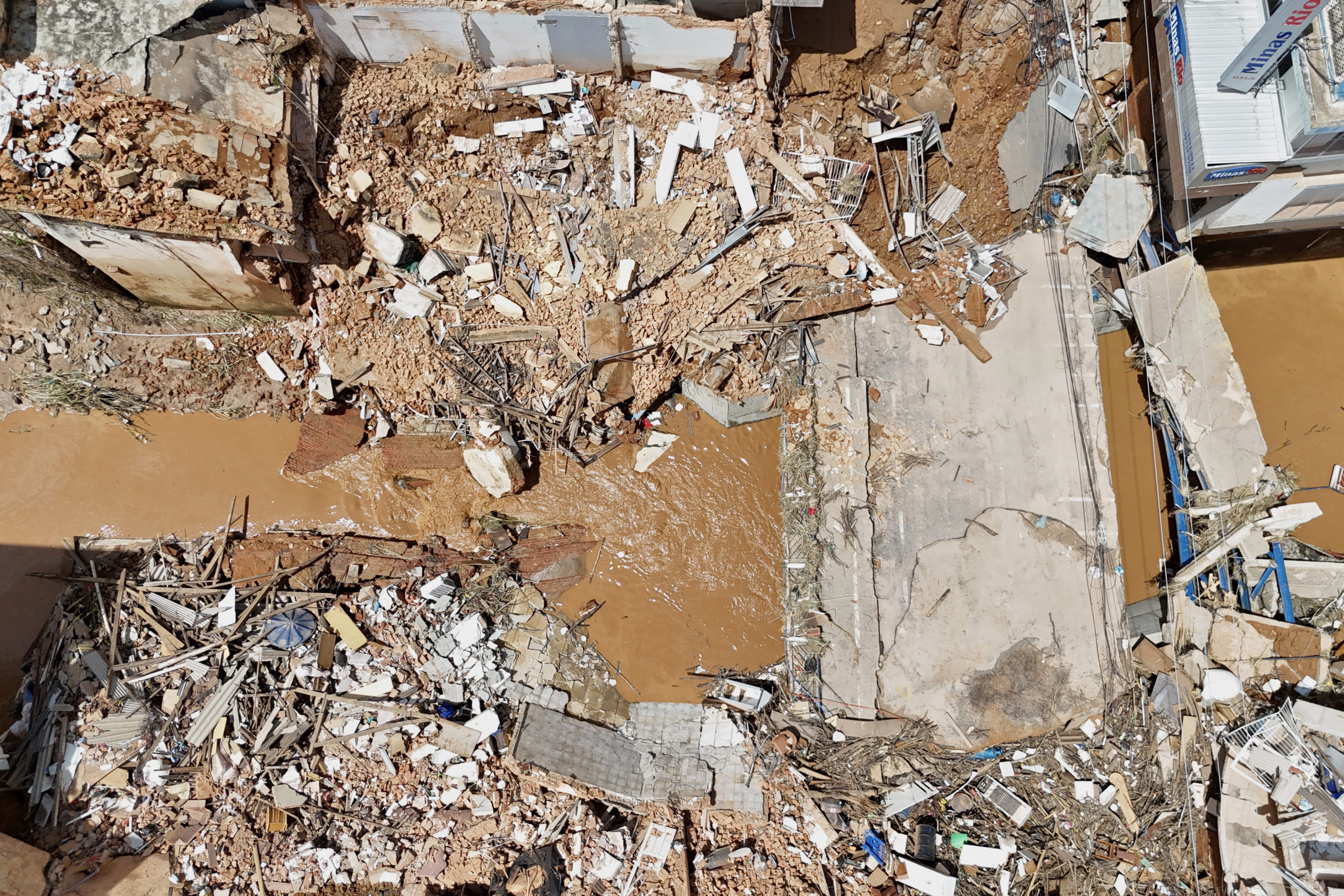 Chuvas atingem Zona da Mata mineira. Foto: Pablo Porciuncula/AFP
With 72 deaths confirmed by March 8th, the tragedy caused by the rainfall in the last week of February in the Minas Gerais (MG) Zona da Mata region is the fourth largest disaster caused by the rain in Brazil in the last decade. In Juiz de Fora, the intense rainfall caused flooding, mudslides and destruction, resulting in dozens of deaths. A similar scenario occurred in Ubá, a neighboring city in the same region. We extend our deepest solidarity to the grieving families, the injured, and the people who lost their homes and livelihood. Each life lost matters, and this type of loss cannot be considered natural.
The grief overcoming the Minas Gerais Zona da Mata is not an isolated event. Rather, it is the symptom of a combination between climate emergency, inequal urban occupation, environmental degradation, and persisting failures of prevention and response on the part of public authorities.
Minas Gerais and the pattern of neglect in socio-environmental disasters
Minas Gerais carries a painful history of major socio-environmental tragedies: the dam collapses in Mariana (2015) and Brumadinho (2019) were some of the most massive environmental disasters in our history. This past sheds light on a pattern of neglect in the face of known risks, which continue to claim lives, particularly among historically vulnerable populations.
Read more

With the recent rainfall, any room for surprise would have been eliminated by data. The National Center for the Monitoring and Alert of Natural Disasters (Cemaden, acronym in Brazilian Portuguese) has accounted for and repeatedly warned of soil instability and the repeated mudslides in Juiz de For a, one of the most affected regions. The city is ranked ninth among the municipalities with the largest at-risk population in Brazil: 130,000 people there live on hillsides.
Even in this scenario, the government of Minas Gerais cut 96% of the state budget originally destined to prevent rainfall impacts. The allocated budget fell from BRL 135 million in 2023 to BRL 6 million in 2025, all meant to serve the 21 million inhabitants of the second most populous state in the country. In 2025, 97% of these funds had been allocated just to attenuate road damage, rather than to the protection of human life.
The problem goes much further than budget cuts. In 2021, only 38% of the 853 municipalities in the state of Minas Gerais had a master plan. Though they are a fundamental means for prevention, only 28% of municipal master plans in Brazil contain plans to prevent floods.
The cycle of promises that do not reach the territory must also be addressed. According to reports from the Folha and Estado de Minas newspapers, a term of commitment for preventive works was signed in July 2024, but requirements and bureaucratic adjustments stalled the proceedings. As informed by the Brasil 247 portal, the technical opinion requested harmonization with a federal risk and disaster management program. The term was extended four times, while important documents like a draft bill, basic project, term of reference of the public notice, and sustainability statement were left unpublished. There was a gap between the warning and the corresponding works, and the rain filled the gap first. This distance between planning and execution is a fine line between life and death.
Conversely, in December 2025, the Belo Horizonte Municipal Council for the Environment (COMAM) passed a ruling that establishes the “Express Renewal of the Environmental License”, under the argument of compatibility with the General Environmental Licensing Act (Law no. 15,190/2025), a law that originates from what has been referred to as the “Devastation Draft Bill”, one of the most decisive attacks against socio-environmental policies since the redemocratization which bolstered the movement to dismantle the main instrument of environmental protection and control in Brazil. Under the rationale of “modernization” and “agility”, new rules have weakened fundamental assessment and control stages, compromising environmental protection and human rights.
Climate adaptation and human rights
Climate adaptation is no longer an agenda for the future; it is, rather, a concrete and measurable necessity. Internationally COP30 reinforced this urgency by passing the text of the Global Goal of Adaptation (GGA) and recognizing, in an unprecedented move, peoples of African descent; the text of the National Adaptation Plans (NAPs) was also passed. These decisions result from a collective effort, particularly from civil society organizations and social movements of the Global South, which act persistently so that the urgency of adaptation may translate into concrete measures in our territories.
At a national level, in December 2025, the Inter-ministerial Committee on Climate Change – CIM (acronym in Brazilian Portuguese) passed the Clima 2024-2035 plan, the main instrument guiding Brazil’s response to the climate crisis by 2035. Conectas was an active participant in the process along with a mobilization of socio-environmental and human rights organizations to present contributions to the National Mitigation and Adaptation Strategies, the Sector-level Mitigation Plans and the Sector-Level and Thematic Adaptation Plans through the Brasil Participativo platform, engaging in permanent dialog with representatives of the MIinistry of the Environment and Climate Change (MMA) and the Board of Policies for Climate Adaptation and Resilience, taking part in countless meetings since the Plan began to be formulated, always with the goal of putting human rights in the forefront of climate action.
Climate adaptation also means reducing social vulnerabilities, since climate disasters don’t affect all people equally. Rather, they merely put environmental racism on display. Solutions based on nature and the knowledge of those who defend it, such as indigenous peoples, quilombolas and traditional communities, added to social participation, should be starting points in any adaptation plan. This is also the moment to address structural determining factors. The urban expansion model that pushes workers to unstable areas and feeds into real estate speculation; the suppression of vegetation; the housing precariousness that persists for successive decades; neglect in the face of high-impact economic activities – all of these factors build climate vulnerability. Public and private sectors have prevention and reparation duties. In Minas, where mining led to unprecedented disasters, socio-environmental responsibility cannot be a matter of mere rhetoric: it is measured by consistent investments in safety, mitigation, and adaptation in the territories affected directly and indirectly by productive chains.
Rainfall and other climate phenomena teach lessons we insist on not learning: without adaptation, there is no way to face the climate crisis.
We extend our respect and solidarity to families in the entire Zona da Mata region of Minas Gerais. Public authorities are called upon to be responsible and act based on evidence. As a society, we are invited to carry out social control and participation to turn the grief of tragedy into structural change.