National Day to Combat Slave Labor: protest in São Paulo denounces violations in the coffee production chain
A protest by rural workers on Avenida Paulista denouncing labor exploitation; Conectas explains why violations persist in the production chain
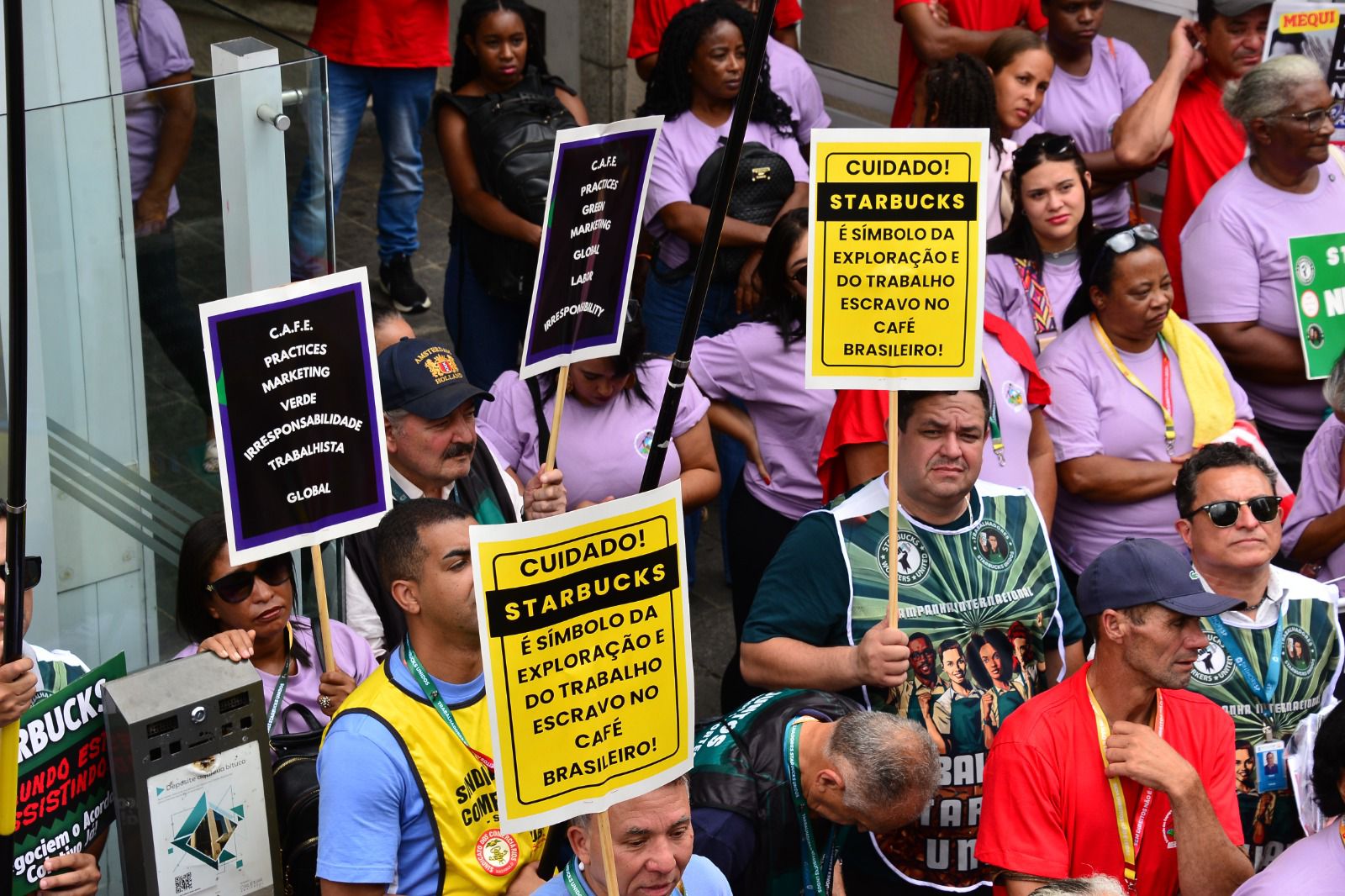 Manifestantes na Avenida Paulista. Foto: Rafael Torres/Reprodução CUT
In São Paulo, on Monday morning (26), rural coffee plantation workers staged a protest on Avenida Paulista, in front of a Starbucks store. The protest was part of a national mobilization for the National Day to Combat Slave Labor (28 January) and denounced the persistence of human rights violations in Brazil’s coffee production chain. As revealed by Repórter Brasil investigations, there have been reports of cases of labor analogous to slavery on farms supplying coffee to the American company.
The protest, organized by the Articulation of Rural Workers of Minas Gerais (ADERE/MG), together with other entities, drew attention to cases analogous to slave labor, precarious working conditions, and the lack of effective corporate accountability throughout the coffee production chain. This situation is ongoing in Brazil. The reports are mainly from the Southern Minas Gerais region, which is strategic in the supply of coffee beans destined for the large global brands of the sector.
During the protest, the organizations also recalled the Unaí massacre in 2004, when three labor inspectors and a driver were murdered on their way to investigate reports of slave labor in the rural area of the municipality of Unaí in Minas Gerais. This case became a landmark in violence against agents of the State and in the resistance of economic sectors to labor inspection.
Read more

Despite institutional progress, contemporary slave labor continues to be a structural issue in Brazil. In 2025, the Ministry for Human Rights and Citizenship (MDHC) received 4,515 reports related to this type of crime, equivalent to an average of 12 cases a day. This figure represents a 14% increase compared with 2024, when 3,959 reports were recorded. The cases include records of the exploitation of adult workers and of child slave labor.
Since 2011, more than 26,000 reports of slave labor have been recorded in Brazil. Rescue data also remain high: in 2024 alone, 2,186 people were removed from conditions analogous to slavery. Since 1995, when the Brazilian State officially recognized the problem, approximately 65,600 workers have been rescued in over 8,400 inspection operations.
The mobilizations underscore the need for structural public policy, more rigorous inspections, transparency in production chains, and the accountability of companies that benefit from labor exploitation—key points in the analyses and denouncements presented by Conectas in its reports on slave labor in Brazilian coffee production.
What contemporary slave labor is in Brazil
Contemporary slave labor in Brazil is characterized by serious rights violations that undermine the freedom and dignity of working people. The practice takes place both in rural areas and in cities, affecting sectors such as civil construction, clothing manufacturing, services, and agricultural activities. In many cases, exploitation is indirect, occurring in outsourced supply chains and through intermediaries responsible for recruitment, debt bondage, and the control of victims.
Unlike slavery of the past, the crime is not limited to physical confinement. It includes strategies such as the retention of documents, the imposition of exhaustive working hours, degrading working and living conditions, restricted access to drinking water and adequate food, as well as the imposition of illegal debts that prevent workers from leaving their jobs. These practices can lead to illness, loss of autonomy, and put lives at risk.
Brazilian legislation defines contemporary slave labor in Article 149 of the Penal Code. According to the law, the crime is characterized by the presence of at least one of the following situations: forced labor; exhaustive working hours; degrading working conditions; or debt bondage, with or without direct restrictions on freedom of movement.
According to the booklet Trabalho escravo: como identificar e combater (Slave Labor: how to identify and combat it) put together by the Articulation of Rural Workers of the State of Minas Gerais (ADERE-MG), with the support of Conectas Human Rights, slave labor “is not a thing of the past” and adapts to social and economic shifts that often go undetected in everyday life.
A crime is deemed to have been committed when the following exist:
- Forced labor;
- Exhaustive working hours;
- Degrading conditions;
- Debt bondage and restrictions on freedom of movement.
The challenges to eradicating slave labor in Brazil
The persistence of contemporary slave labor in Brazil is linked to structural barriers that hinder both its prevention and its eradication. One of the key factors is the lack of transparency in production chains, which are made up of multiple levels of outsourcing and subcontracting. This fragmentation dilutes responsibility, hides the ultimate beneficiaries of exploitation, and makes it difficult to hold companies accountable along the chain.
Furthermore, precarious public policies regarding inspection continue to be one of the principal obstacles. Scarce resources, an insufficient number of inspectors, and budgetary instability compromise the regularity of inspections, particularly in remote regions and in sectors with a high turnover of workforce. When there are budget cuts, operations become sporadic and reactive, undermining the State’s capacity to take preventive actions.
Social inequalities exacerbate this situation. Black people, migrants, workers with low levels of education, and impoverished communities are more vulnerable to recruitment, false promises of employment, and fraudulent loan schemes. As highlighted in the booklet Slave Labor: how to identify and combat it, factors such as poverty, unemployment, and social vulnerability continue to fuel the cycle of exploitation in the country.
Another significant challenge is the rise in contemporary slave labor in urban areas. The increase in rescues at construction sites, clothing factories, logistics, and domestic work indicates that the response to this issue cannot be confined to rural areas. State action must include territorial intelligence, data analysis, coordination with municipal authorities, and improving reporting channels accessible to the population.
Urgent agenda for action
Faced with this scenario, experts and civil society organizations have identified the guarantee of stable resources for labor inspection, including rebuilding teams and technical autonomy, as a priority. Recent incidents of political interference in instruments key to combating this, such as the so-called ‘Dirty List’ of slave labor, have raised concerns about the risk of undermining internationally recognized policies.
To preserve the credibility of the system, it is essential to ensure that these mechanisms are safeguarded from political pressure, with technical decision-making, transparency, periodic updates, and binding use in credit policies, public procurement, and tax incentives. The ongoing independence and effectiveness of instruments such as the Dirty List bolsters the fight against slave labor and provides legal certainty to companies committed to decent work.
There is also a growing need to establish mandatory human rights due diligence in production chains, including traceability, risk assessment, and joint liability across all links in the chain, not only the immediate employer. The ADERE-MG booklet highlights that failure to hold employers and beneficiary companies accountable contributes to recurrence and impunity.
However, the State’s response cannot be restricted to inspection. Full reparation for victims—including access to housing, healthcare, documentation, legal assistance, professional training, and productive inclusion—is essential to break the cycle of vulnerability that underpins this violation.
Without coordinated governance between Federal Government, states, municipalities, and civil society together with transparency, corporate accountability, and effective protection of victims, the country will continue to respond to emergencies, without addressing the structural causes of contemporary slave labor.
How to report a violation
Reports can be made free of charge and anonymously through the Disque 100 hotline (Human Rights) or via the digital channels of the Ministry of Labor and Employment (MTE/SIT) and the Labor Prosecution Service (MPT).
In cases of imminent risk, individuals are advised to immediately contact local authorities.