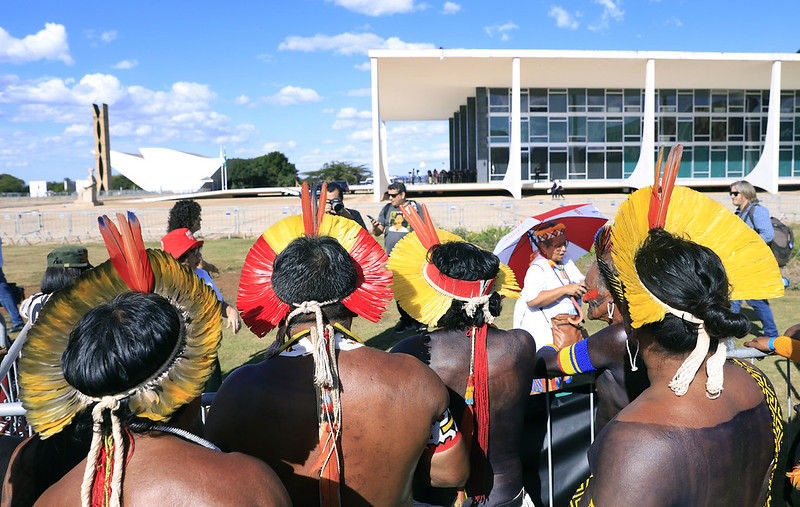
Indigenous peoples and human rights NGOS challenge the dismantling of environmental licensing at the Federal Supreme Court
The action challenges laws approved in 2025 that undermine environmental licensing, create a Special Environmental License, and expand automatic licensing for medium level impact activities
 Protesto na Av. Paulista contra projeto que enfraquece licenciamento ambiental. Foto: Cris Faga/NurPhoto via AFP
Following National Congress’s approval of a new legal framework that profoundly changes environmental licensing in Brazil—a measure civil society organizations are calling the “Devastation Bill”—a series of actions have been filed with the Federal Supreme Court (STF) challenging the constitutionality of the changes. Among them is Direct Action of Unconstitutionality (ADI) 7919, filed by the Articulation of Indigenous Peoples of Brazil (Apib) and the Socialism and Freedom Party (PSOL).
Conectas is participating in the case as amicus curiae, alongside Greenpeace Brasil, The Socioenvironmental Institute (ISA), WWF-Brasil, SOS Mata Atlântica, The National Coordination for the Articulation of Rural Black Quilombola Communities (Conaq), Instituto Alana, Avaaz, The Climate Observatory, as well as Alternativa Terrazul, Arayara and the Institute for Democracy and Citizenship (IDC).
The action contests provisions of Law No. 15.190/2025, known as the General Environmental Licensing Law, and Law No. 15.300/2025, which established the Special Environmental License (LAE). According to the authors, the new model undermines the environmental oversight framework built up over decades and represents the largest socioenvironmental setback since redemocratization.
Read more

Environmental licensing is one of the principal tools for the prevention of socioenvironmental and climate disasters in Brazil. By requiring impact studies, technical analysis, the establishment of conditions, and social participation, the mechanism is able to anticipate risks, avoid irreversible damage to ecosystems, and safeguard vulnerable communities. According to experts and socioenvironmental organizations weakening it increases the likelihood of tragedies associated with large-scale ventures, such as dam collapses, contamination of rivers, deforestation, and the worsening of the climate crisis.
One of the key issues raised in ADI 7919 is the creation of the Special Environmental License, a mechanism that allows for the fast-tracked granting of licenses for projects deemed “strategic” by the Government Committee. Every two years, the committed is required to draw up a list of these projects, to be submitted to the President of the Republic. According to PSOL and Apib, the law fails to establish technical and objective criteria for defining what constitutes a strategic project, leaving room for decisions based on political interests rather than technical assessments grounded in scientific evidence.
In the view of the authors, definitions of this kind should be entrusted to technical bodies with diverse representation, such as the National Environment Council (Conama), which has historically been responsible for setting standards and parameters aimed at environmental protection. They argue that the absence of these criteria increases the Executive Branch’s discretion and weakens legal certainty in licensing.
The action also challenges the expansion of the License by Adherence and Commitment (LAC) to activities with medium pollution potential. Under this mechanism, licenses are automatically granted online, solely on the basis of a statement by the project developer, with no prior technical review or mandatory inspection, and with oversight carried out on a sampling basis alone. The authors describe the mechanism as a form of “self-licensing” and argue that it compromises the monitoring of potentially harmful activities.
Although the Federal Supreme Court has declared the impossibility of the LAC concession being applied to mining activities, projects such as large-scale hydroelectric plants could be approved using LAE. According to Apib and PSOL fast-tracking political decisions on complex, high-impact projects disregards the technical complexity involved and increases risks for Indigenous peoples, Quilombola communities, and other traditional territories.
Another issue being challenged is the decentralization of definitions regarding which activities do or do not require environmental licensing. According to the ADI, this regulatory fragmentation leads to legal uncertainty and could fuel an “environmental war” among states and municipalities, which could begin to compete for investment by adopting less stringent environmental standards, in a dynamic which resembles the fiscal war.
What ADI 7919 is asking of the STF
In the initial petition, the authors present three main categories of requests, combining urgent measures, direct constitutional challenges, and requests for interpretation in conformity with the Constitution.
The first is for the granting of a preliminary injunction to suspend the effects of all challenged provisions while the case is under review by the Supreme Court. According to the authors, the urgency is justified both by the risks posed by the implementation of the General Law and by the rules of the LAE, described as a license driven by political pressure to enable projects with major socioenvironmental impacts. The LAE has been in force since the issuance of Provisional Measure No. 1.308/2025, in August, while the remainder of the General Law is set to enter into effect on February 4, 2026, National Congress having overridden the 52 vetoes of the Executive Branch.
The second request seeks a declaration of unconstitutionality, in whole or in part, of 29 articles of the General Environmental Licensing Law and of 6 articles of the LAE Law. The provisions in question include the lack of effective oversight of the License by Adherence and Commitment, described as a form of self-licensing; the simplification of the licensing by political decision in the case of the LAE; the weakening of the Atlantic Forest Law; the excessive delegation of powers to states and municipalities, undermining the role of the Union in the definition of general standards; the facilitation of the regularization of projects installed irregularly; and the undue reduction of the socioenvironmental liability of financial institutions.
The third request asks the STF to provide an interpretation, in conformity with the Constitution, for eight provisions of the General Law, in order to safeguard constitutional principles and established case law. Among others, the action underscores the need for suitable rules for handling hazardous waste, the mandatory hearing of the relevant authorities in all Indigenous and Quilombola territories affected either directly or indirectly by ventures and the inclusion of variables regarding climate change. The authors note that this matter is not even mentioned in the new legislation.
Indigenous and Quilombola communities
According to Apib, the impacts of the new framework go beyond the easing of environmental controls and directly infringe on the rights of Indigenous peoples. “The new legislation is not only the biggest environmental setback in the last 40 years, but is also one of the most serious attacks on Indigenous peoples since redemocratization. The weakening of Funai’s role in licensing procedures, the disregard for Indigenous lands that have not yet been formally demarcated, and the erosion of the right to free, prior, and informed consultation place the Indigenous communities of Brazil, as well as the biomes they protect, at risk,” said Ricardo Terena, legal coordinator at Apib.
“While the Devastation Bill was moving through Congress, we warned that dismantling environmental licensing was the greatest socioenvironmental setback since redemocratization and would amount to an unprecedented violation of human rights,” said Thales Machado, Advisor to Conectas’ Defending Socioenvironmental Rights program. “Now that it has become law, with the approval of the LAE and with vetoes overridden by Congress, this risk has become a reality: the legislation undermines technical procedures and social participation, expands exemptions and authorizes forms of self-licensing without effective studies, replacing prevention with political convenience and allowing environmental and climate denialism to provide the guidelines for high-impact ventures.”
Machado also emphasizes that by institutionalizing practices that expose Indigenous peoples, Black people, Quilombola communities, and other marginalized communities to dangerous levels of pollution and contamination, the law violates the right to an ecologically balanced environment, compromises public health, and runs counter to climate justice.
STF Actions
The case is with the Supreme Court, under the rapporteurship of Justice Alexandre de Moraes. In addition to ADI 7919, the STF is reviewing two other actions on the matter. ADI 7913 filed by the Green Party (PV), challenges provisions that ease environmental licensing and waive prior impact assessment. And ADI 7916, filed by the Rede Sustentabilidade and Anamma, contests changes to the framework of federal cooperation, arguing that amendments to licensing competencies may only be made through a complementary law.
Taken together, the actions place the Supreme Court at the center of the debate on the constitutional limits on easing environmental licensing, the role of the State in preventing socioenvironmental and climate disasters, and the protection of the rights of Indigenous peoples, traditional communities, and society as a whole.